
Explosion-Proof Forklift Zone Selection
Zone Selection for Explosion-Proof Forklifts
1. Why the zone defines the truck, not the other way round
In explosive atmospheres the equipment follows the area classification. You do not buy a truck and then decide where it may work; you classify the area first, then select equipment that is permitted in that zone. Getting this order wrong is the most common and most expensive mistake in explosion-proof procurement.
This whitepaper explains how zones are defined, what equipment each zone permits, how the gas group and temperature class narrow the choice, and what to specify in an enquiry.
It is written for plant engineers, EHS managers and procurement teams in chemical, paint, coating, pharmaceutical and food processing operations, and for distributors who need to explain the requirements to their own customers.
This document is general guidance only. Final selection must be confirmed against your national regulations and the actual area classification drawing for your site.
2. Zone classification
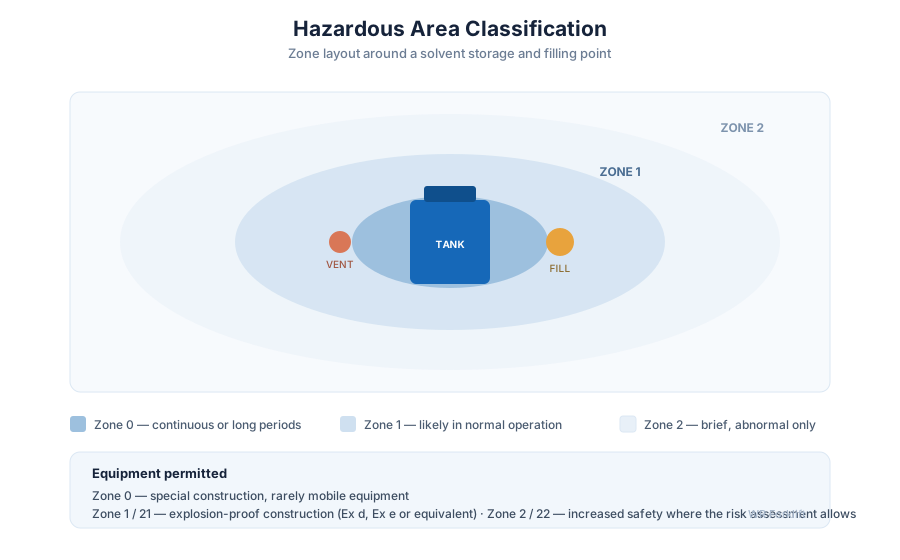
Areas are classified by how likely an explosive atmosphere is to be present.
| Zone | Definition | Typical example |
|---|---|---|
| Zone 0 | Explosive atmosphere present continuously or for long periods | Inside a solvent tank, inside a vessel |
| Zone 1 | Likely to occur in normal operation | Immediately around a tank vent, filling point |
| Zone 2 | Not likely in normal operation, and if it occurs, only briefly | Around a flange in a well-ventilated area |
| Zone 20 | Combustible dust present continuously or for long periods | Inside a dust collector, inside a silo |
| Zone 21 | Dust likely to occur in normal operation | Near a bag dump station, filling point |
| Zone 22 | Dust not likely in normal operation, only briefly | Around equipment in a well-ventilated area |
Zones 0 and 20 are the most severe. In practice, most powered industrial trucks operate in Zone 1, 2, 21 or 22. Equipment for Zone 0 or 20 is a specialised engineering project.
3. What each zone permits
| Zone | Typical equipment approach | Notes |
|---|---|---|
| Zone 0 / 20 | Special construction, rarely mobile equipment | Discuss with a specialist; most trucks are not permitted |
| Zone 1 / 21 | Explosion-proof construction (Ex d, Ex e or equivalent) | The most common requirement for trucks in chemical plants |
| Zone 2 / 22 | Increased safety, or explosion-proof where required by the risk assessment | Some operations can use less stringent equipment |
An explosion-proof truck is not simply a truck with sealed electrics. It is a truck in which every potential ignition source has been addressed: motors, controllers, wiring, switches, lighting, battery, and the mechanical parts that can generate sparks or hot surfaces through friction or impact.
4. Gas group and temperature class
Two more parameters narrow the selection further.
Gas group describes the ignition sensitivity of the gas. Groups are commonly written as IIA, IIB and IIC, with IIC being the most easily ignited (hydrogen, acetylene). For dust, groups are IIIA (combustible flyings), IIIB (non-conductive dust) and IIIC (conductive dust).
Temperature class describes the maximum surface temperature the equipment may reach. Common classes are T1 (450 °C) through T6 (85 °C). The equipment's maximum surface temperature must stay below the ignition temperature of the gas or dust present.
| Class | Max surface temp | Typical gases |
|---|---|---|
| T1 | 450 °C | Methane, hydrogen |
| T2 | 300 °C | Ethylene |
| T3 | 200 °C | Petrol, hexane |
| T4 | 135 °C | Acetaldehyde, diethyl ether |
| T5 | 100 °C | (rarely required) |
| T6 | 85 °C | Carbon disulphide |
The practical point: a truck marked for IIB T4 is not automatically suitable for a plant handling hydrogen (IIC) or carbon disulphide (T6). The marking on the nameplate must cover the gas group and temperature class of the actual material.
5. Where ignition sources hide
When evaluating a truck, work through every source.
Electrical
- Drive and pump motors
- Controller and contactors
- Wiring, connectors, junction boxes
- Lighting, indicators, horns
- Battery and charging connectors
- Sensors and switches
Thermal
- Motor surface temperature under load
- Brake surfaces
- Exhaust, on engine-powered units
- Hydraulic oil temperature
Mechanical sparks
- Fork and frame contact with the floor or racking
- Steel wheels or forks striking concrete
- Metal-to-metal impact during load handling
Static electricity
- Non-conductive wheels or seat materials
- Plastic components and dust build-up
Every one of these must be addressed in an explosion-proof build. This is the reason an explosion-proof truck costs significantly more than a standard truck of the same capacity, and why a quotation that is only marginally more expensive should be examined closely.
6. Built as explosion-proof vs converted
There are two routes to an explosion-proof truck and they are not equivalent.
| Purpose-built | Converted from standard | |
|---|---|---|
| Design basis | Explosion protection designed in from the start | Standard truck modified afterwards |
| Motors | Explosion-proof rated | Standard motors enclosed or replaced |
| Wiring | Rated throughout | Partly re-routed |
| Certification | Type examination on the complete truck | Depends on the converter's scope |
| Weight and balance | Accounted for in design | Added protection changes weight and balance |
| Service access | Designed for maintenance | Often restricted |
A conversion can be appropriate for a small number of units or an urgent requirement, but it should be judged on what was actually certified, not on the price difference. Ask for the certification scope.
7. What to put in the enquiry
Give the supplier these items and the quotation will be comparable.
- Zone — 1, 2, 21 or 22, and the area classification drawing reference
- Gas group or dust group — IIA, IIB, IIC, or IIIA, IIIB, IIIC
- Temperature class — T1 to T6
- Substance handled — the actual material, not just the group
- Capacity and lift height required
- Aisle width and racking type
- Shift pattern and whether the truck stays in the zone or moves in and out
- Charging location — inside the zone, or in a safe area
- Applicable standard — ATEX, IECEx, or your national equivalent
- Documentation required — certificate, nameplate details, manual
Item 4 matters more than people expect. Two gases can share a group but have different ignition behaviour, and the material actually handled should drive the final check.
8. Charging an explosion-proof truck
Battery charging releases hydrogen. In an explosive atmosphere this is itself a hazard, and the charging location becomes part of the classification.
Options in practice:
- Charge outside the zone in a designated, ventilated charging room. Simplest and most common.
- Charge inside the zone with a charging system rated for the area. Possible but significantly more expensive and requires careful ventilation design.
- Battery exchange — swap a depleted battery for a charged one, with exchange carried out in a safe area.
Deciding the charging strategy late in the project is a common cause of delay. It should be settled at the same time as the zone classification.
9. Common mistakes
Buying a truck and then classifying the area around it. The classification comes first.
Accepting "explosion-proof" without a marking. Ask for the nameplate details: group, temperature class, certificate number.
Matching the zone but not the gas group. Zone 1 IIB T4 equipment is not suitable for a IIC or T6 material.
Ignoring the mechanical ignition sources. Sparking from forks or wheels on concrete is a real ignition path, and it is not solved by the electrical certification.
Leaving charging until the end. The charging location affects the classification and the truck specification.
Assuming a converted truck is equivalent. Check the certification scope, and what the conversion did to weight, balance and service access.
Not reviewing the classification after a process change. Adding a solvent, changing a material or altering ventilation can change the zone.
10. Summary
Explosion-proof selection is a sequence, not a single decision:
- Classify the area (zone).
- Identify the substance (gas group, temperature class).
- List every ignition source and confirm how each is addressed.
- Decide the charging strategy.
- Confirm the certification scope covers the complete truck.
- Verify the nameplate matches your classification.
Do these six in order and the equipment will be compliant. Skip any one and the risk moves to the operator.
This whitepaper is published by WR Forklift (Taizhou Worui Warehousing and Logistics Equipment Co., Ltd.) as general guidance for equipment selection in potentially explosive atmospheres. It does not replace your national regulations, your area classification drawing, or the assessment of a qualified safety engineer. Confirm the final specification with your supplier against your actual site conditions.
Contact: sales@wrforklift.com · +86 180 5267 6182 · www.wrforklift.com
Download this whitepaper as a PDF - take it to your next meeting.
Looking for equipment for this application?
See special application trucks