A forklift rated 1500 kg does not lift 1500 kg in every situation. Load centre, residual capacity and the data plate explained with worked examples.
TSG 81—2022 — Safety Technical Regulation for Special Purpose Motor Vehicles in Plants, State Administration for Market Regulation (China)GB/T 26560 — Industrial Trucks — Vocabulary, National Technical Committee for Industrial Truck StandardisationGB/T 23794-2023 — Enterprise Credit Evaluation Indicators, National Technical Committee for Social Credit StandardisationISO 3691 series — Industrial trucks — Safety requirements and verification, ISOEN 1175:2020 — Safety of industrial trucks — Electrical requirements, CENWhy the same truck carries different loads at different load centres.
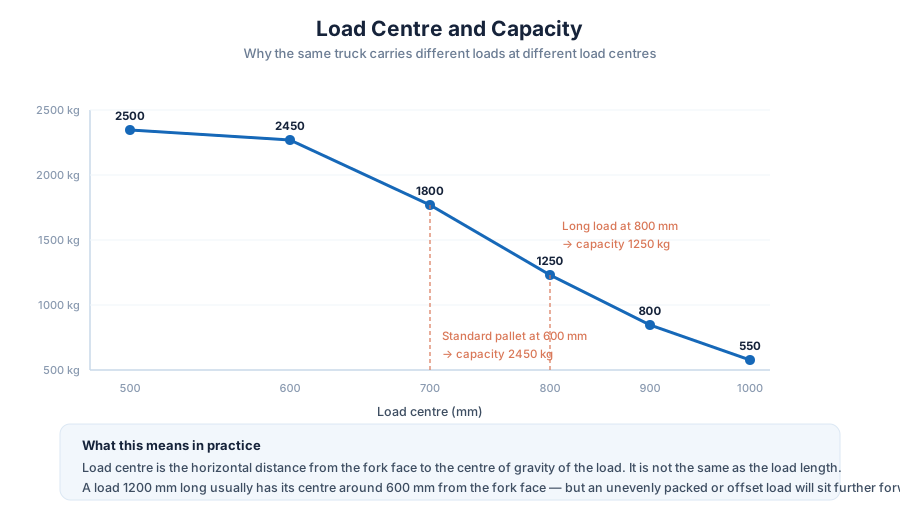
A forklift rated 1500 kg does not lift 1500 kg in every situation. Load centre, residual capacity and the data plate explained with worked examples.
Last updated: 11 October 2026
A 1.5 t forklift is rated 1,500 kg — but only at a specific load centre. Move the load further out and the safe capacity drops, often dramatically. This is the most misunderstood number in material handling, and the cause of a large share of tip-over accidents.
Load centre is the horizontal distance from the front face of the forks to the centre of gravity of the load. A standard 1,200 × 1,000 mm pallet loaded evenly has its centre of gravity about 500 mm from the fork face — so 500 mm is the standard rating point on most trucks.
| Load centre | Effect on a 1,500 kg rated truck |
|---|---|
| 500 mm | 1,500 kg — full rated capacity |
| 600 mm | Roughly 1,250 kg — about 17% lost |
| 700 mm | Roughly 1,070 kg — about 29% lost |
| 900 mm | Roughly 830 kg — about 45% lost |
Those figures are indicative and vary by mast and truck — always read the data plate on the specific machine. The pattern holds everywhere: capacity falls roughly in proportion to load centre, because the truck is a lever and you have just lengthened the lever arm.
If a supplier quotes you a capacity without asking for your load centre and lift height, they have not sized the truck.
Send us your load weight, lifting height and aisle width — we will recommend the right model.
