A clear explanation of forklift stability — the stability triangle, longitudinal and lateral tip-over, and the operator actions that cause most incidents.
TSG 81—2022 — Safety Technical Regulation for Special Purpose Motor Vehicles in Plants, State Administration for Market Regulation (China)GB/T 26560 — Industrial Trucks — Vocabulary, National Technical Committee for Industrial Truck StandardisationGB/T 23794-2023 — Enterprise Credit Evaluation Indicators, National Technical Committee for Social Credit StandardisationISO 3691 series — Industrial trucks — Safety requirements and verification, ISOEN 1175:2020 — Safety of industrial trucks — Electrical requirements, CENWhy a counterbalance forklift tips, and what pushes the centre of gravity outside the triangle.
A clear explanation of forklift stability — the stability triangle, longitudinal and lateral tip-over, and the operator actions that cause most incidents.
Last updated: 11 October 2026
A forklift is a see-saw with a counterweight. Understanding that one sentence prevents most tip-over accidents.
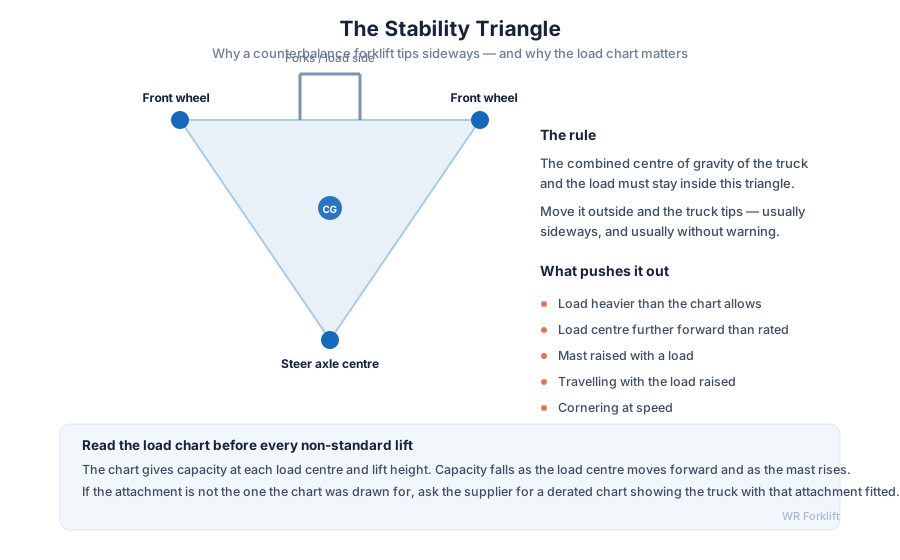
Draw a line between the two front wheels, then a line from each front wheel back to the centre of the steer axle. You now have a triangle. The truck and its load have a combined centre of gravity, and that point must stay inside the triangle at all times.
When it moves outside, the truck tips — and it tips in the direction it is least stable, which is not always the direction the operator expects.
Caused by the combined centre of gravity moving forward past the front axle. The usual triggers:
Caused by the centre of gravity moving sideways past a line between a front and a rear wheel. The usual triggers:
That last point surprises people. Operators who jump are crushed by the overhead guard; operators who stay in the seat inside the restraint system usually walk away. It is the reason seat belts on forklifts matter as much as they do in a car — not to stop you being thrown out, but to stop you jumping.
Send us your load weight, lifting height and aisle width — we will recommend the right model.
