A step-by-step guide to reading a forklift data plate and load chart, including load centre, residual capacity, attachment derating and mast types.
TSG 81—2022 — Safety Technical Regulation for Special Purpose Motor Vehicles in Plants, State Administration for Market Regulation (China)GB/T 26560 — Industrial Trucks — Vocabulary, National Technical Committee for Industrial Truck StandardisationGB/T 23794-2023 — Enterprise Credit Evaluation Indicators, National Technical Committee for Social Credit StandardisationISO 3691 series — Industrial trucks — Safety requirements and verification, ISOEN 1175:2020 — Safety of industrial trucks — Electrical requirements, CENWhy the same truck carries different loads at different load centres.
A step-by-step guide to reading a forklift data plate and load chart, including load centre, residual capacity, attachment derating and mast types.
Last updated: 11 October 2026
Every forklift carries a data plate. Most operators have never read one properly, and most buyers have never been shown one. It is the single most important document on the machine.
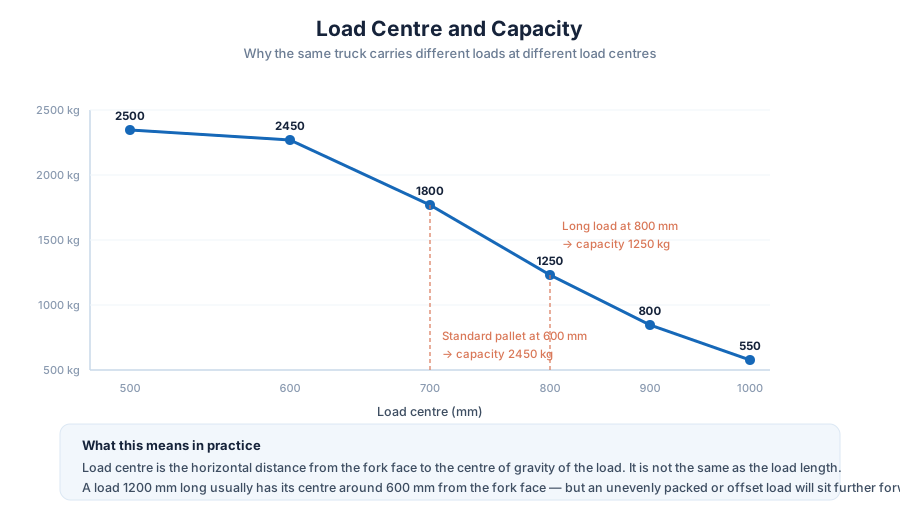
Measure from the vertical face of the forks to the centre of gravity of the load. For a standard 1,200 × 1,000 mm pallet loaded evenly, that is 500 mm. Add any overhang. If you handle two pallets at once, or a long load, this number grows fast.
Top beam height, plus pallet height, plus 100 mm clearance. Then look at the chart. A mast is a column under bending load; the higher you go, the less it lifts. On many trucks the usable capacity at 6 m is 20 – 30% below the plate figure.
A side-shifter moves the load forward 100 – 150 mm, which increases the effective load centre. A clamp, rotator or push-pull adds its own weight and moves the centre further still. The plate should state the derated figure; if the truck has an attachment and the plate does not mention it, the plate is out of date.
Never plan to run at exactly 100% of rated capacity. Loads shift, pallets are heavier than the label says, and operators are human. A 10 – 15% margin is normal practice.
| Parameter | Value |
|---|---|
| Truck rated capacity | 2,000 kg at 500 mm load centre |
| Your pallet | 1,200 × 1,000 mm, evenly loaded |
| Your load centre | 500 mm |
| Your lift height | 4,500 mm |
| Residual capacity at 4.5 m | about 1,700 kg (from the chart) |
| Your actual load | 1,850 kg |
| Verdict | **Over capacity — the truck is too small** |
This is the calculation that catches people out. A "2-tonne" truck that cannot lift a 1,850 kg pallet to 4.5 m is not a faulty truck — it is a truck being asked to do something it was never rated for.
Send us your load weight, lifting height and aisle width — we will recommend the right model.
