
Forklift Attachment Selection Guide
Forklift Attachment Selection Guide
1. Why attachments are specified backwards
Most attachment problems start with the same mistake: the truck is chosen first and the attachment is fitted afterwards. The attachment then reduces the truck's capacity, changes its stability, and in some cases voids part of the warranty or makes the truck non-compliant.
The correct sequence is: define the load, choose the attachment for that load, then choose a truck that carries the attachment and the load together.
This guide covers the main attachment families, how each one affects capacity, what information is needed to specify correctly, and the checks that prevent the expensive mistakes.
It is written for warehouse and production engineers, procurement teams, and distributors specifying attachments for their own customers.
2. The load comes first
Before considering any attachment, answer these questions about the load.
| Question | Why it matters |
|---|---|
| What is the load? | Determines the attachment family |
| What does it weigh? | Determines capacity requirement |
| What are its dimensions? | Determines the attachment size, not just the truck |
| Is it rigid, flexible, or loose? | Rigid loads use forks, flexible loads need clamping |
| Is it uniform, or does it vary? | Variable loads need a wider working range |
| Is it damaged by pressure? | Determines clamping force limits |
| Does it need to stay upright? | Determines whether a rotator or positioner is needed |
| Is it food, chemical, or hazardous? | Determines material and washdown requirements |
| Does it need to be weighed? | Determines whether a scale is integrated |
The unit load, not the individual item, is what the attachment handles. Measure the unit load as it will actually be presented in the warehouse, including any pallet, slip sheet or strapping.
3. Attachment families
| Family | Handles | Typical applications |
|---|---|---|
| Side shifter | Standard pallets, incremental adjustment | Almost all pallet handling; the most common attachment |
| Fork positioner | Pallets of varying width | Operations handling multiple pallet standards |
| Carton clamp | Boxed goods, appliances | White goods, appliances, boxed freight |
| Bale clamp | Baled material | Recycling, paper, textiles, agriculture |
| Roll clamp | Paper rolls, cable drums | Paper mills, printing, film and foil |
| Drum clamp | Steel and plastic drums | Chemical, paint, oil, food processing |
| Push-pull | Slip sheets | Slip-sheet operations, truck loading |
| Rotator | Bins, boxes needing tipping | Waste, foundry, food processing |
| Tipping fork | Containers being emptied | Waste handling, production lines |
| Extending forks (reach) | Double-deep or difficult access | Racking where a standard fork cannot reach |
| Man basket / work platform | Personnel lifting | Maintenance, order picking at height |
| Crane jib | Suspended loads | Construction material, long goods |
| Fork-mounted sweep | Loose material on the floor | Cleanup, agriculture |
| Integral scale | Weighing while handling | Any operation needing weight capture |
| Multiple pallet handler | Several pallets at once | High-volume distribution |
Each of these changes the truck's load chart. Not one of them is a neutral addition.
4. Capacity loss: the number that gets missed
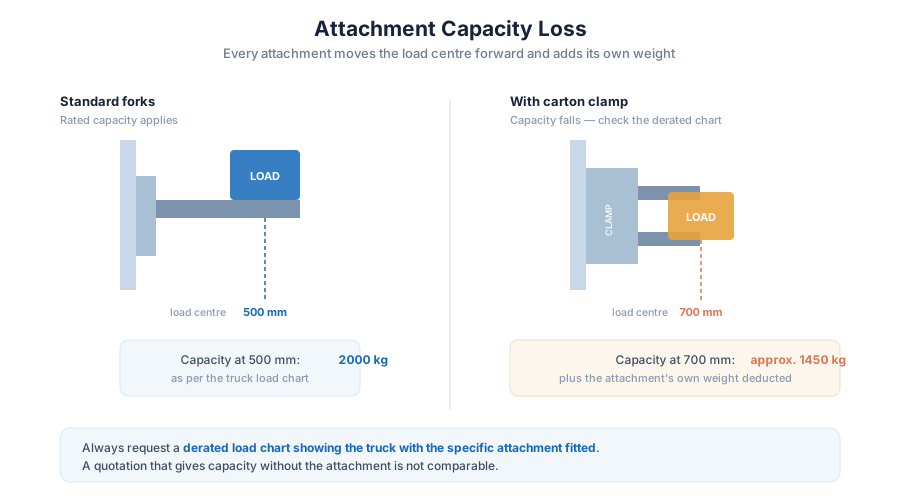
Any attachment moves the load centre forward and adds its own weight. Both reduce the capacity the truck can actually handle.
Two effects combine:
Attachment weight. The attachment is carried by the mast, so its weight is deducted from the available capacity at every load centre.
Load centre shift. Forks are typically 500 mm from the fork face to the load centre. A clamp, rotator or push-pull attachment may add 200 to 500 mm or more of thickness, moving the load centre forward. Capacity falls as load centre increases; the rate is given by the truck's load chart.
The practical consequence:
| Attachment | Typical effect |
|---|---|
| Side shifter only | Small capacity loss, load centre shift of roughly 100 mm |
| Fork positioner | Similar to side shifter |
| Carton or bale clamp | Significant; the clamp arms and frame move the centre forward |
| Roll clamp | Significant, and often needs a dedicated truck |
| Rotator | Significant; the rotator adds height as well as thickness |
| Push-pull | Significant thickness added |
| Multiple pallet handler | Large; usually a dedicated truck specification |
Always ask for a derated load chart showing the truck with the specific attachment fitted. A quotation that gives capacity without the attachment is not comparable.
5. Hydraulics: how many functions
The truck's hydraulic system must supply every function the attachment needs. Count them.
| Attachment | Functions required |
|---|---|
| Side shifter | 1 |
| Fork positioner | 1 (both forks together) or 2 (independent) |
| Carton / bale / roll clamp | 1 (open-close) |
| Clamp with rotation | 2 (open-close plus rotate) |
| Rotator | 1 (rotate) or 2 (rotate plus clamp) |
| Push-pull | 2 (push-pull plus clamp) |
| Tipping fork | 1 or 2 |
A truck ordered with one auxiliary function cannot run a two-function attachment. Adding a function later means new valves, new hoses and possibly a different mast. This is one of the most expensive late changes in a forklift order, and it is entirely avoidable by counting the functions at the specification stage.
6. Clamping force and load protection
For any clamping attachment, the relationship between holding the load and crushing it is the central design question.
Points to establish:
- Minimum force needed to hold the load securely during travel and braking.
- Maximum force the load can withstand without deformation or damage.
- Whether pressure can be regulated so the operator can adjust for different loads.
- Whether the load changes during the shift. A clamp set for one product may crush another.
For crushable loads, a pressure regulator or a load-sensing arrangement is usually necessary. Specifying a clamp without establishing the allowable pressure range is how damaged stock happens.
7. What to send when requesting a quotation
Provide all of the following and the quotation can be checked rather than guessed at.
- Load description and a photograph if possible
- Unit load weight, including pallet or packaging
- Unit load dimensions — length, width, height
- Load centre as presented
- Attachment type required, and the number of hydraulic functions
- Truck capacity and lift height available or required
- Aisle width and racking type
- Environment — cold store, washdown, dust, or potentially explosive atmosphere
- Shift pattern and duty cycle
- Any regulatory requirement — for example personnel lifting, which changes the compliance position entirely
Item 10 deserves emphasis. An attachment used to lift people is not a standard attachment with a basket fitted. It carries specific requirements for the platform, the guarding, the control position, the hydraulic system and the certification.
8. Costs people forget
The attachment price is not the whole cost.
- Derated capacity — you may need a larger truck to handle the same load, which costs more than the attachment
- Extra hydraulic function — valves, hoses, sometimes a different mast
- Additional counterweight in some cases
- Longer lead time — attachments are often built to order
- Spare parts — seals, hoses and wearing parts specific to the attachment
- Operator training — clamping and rotating attachments change how the truck is driven
- Maintenance access — some attachments make routine service harder, extending downtime
9. Common mistakes
Choosing the truck before the attachment. The sequence determines whether the solution works.
Using rated capacity instead of derated capacity. The truck's headline capacity is for standard forks at a standard load centre.
Not counting hydraulic functions. A late addition is expensive.
Specifying a clamp without a pressure limit. Damaged loads, and a warranty discussion.
Ignoring the environment. A clamp that works in a dry warehouse may not survive washdown or a freezer.
Forgetting the operator. A rotator or clamp changes the driving task; without training, the attachment is used incorrectly.
Assuming the attachment is interchangeable. Fitting a different attachment to the same truck may exceed the derated capacity or the hydraulic capability.
10. Summary
Attachment selection follows a fixed order:
- Define the unit load precisely.
- Choose the attachment family for that load.
- Count the hydraulic functions needed.
- Calculate the capacity loss and confirm the derated load chart.
- Check the environment and the material.
- Confirm the compliance position if people are being lifted.
- Compare quotations on the derated capacity, not the attachment price.
Do it in this order and the attachment becomes part of a working system. Do it in the wrong order and it becomes an expensive retrofit.
This whitepaper is published by WR Forklift (Taizhou Worui Warehousing and Logistics Equipment Co., Ltd.) as general guidance on attachment selection. Capacity figures, load charts and compliance requirements are specific to each truck and application; confirm the final specification with your supplier.
Contact: sales@wrforklift.com · +86 180 5267 6182 · www.wrforklift.com
Download this whitepaper as a PDF - take it to your next meeting.
Looking for equipment for this application?
See special application trucks